Following an old mountain road that still remembers its past
It doesn’t feel like a tourist route
The Silk Route doesn’t begin with a grand entrance.
There’s no clear starting point where everything suddenly changes.
Instead, it unfolds slowly —
through quiet roads, small villages, and stretches where the mountains seem closer than expected.
By the time you realise where you are,
you’re already part of it.
A road that carries history
Long before it became a travel route, this was a trade path.
Goods moved through these mountains, connecting regions that now feel far apart.
Today, the movement is different —
travellers instead of traders, cameras instead of caravans.
But the road still holds that sense of passage.
Of crossing through, rather than arriving.
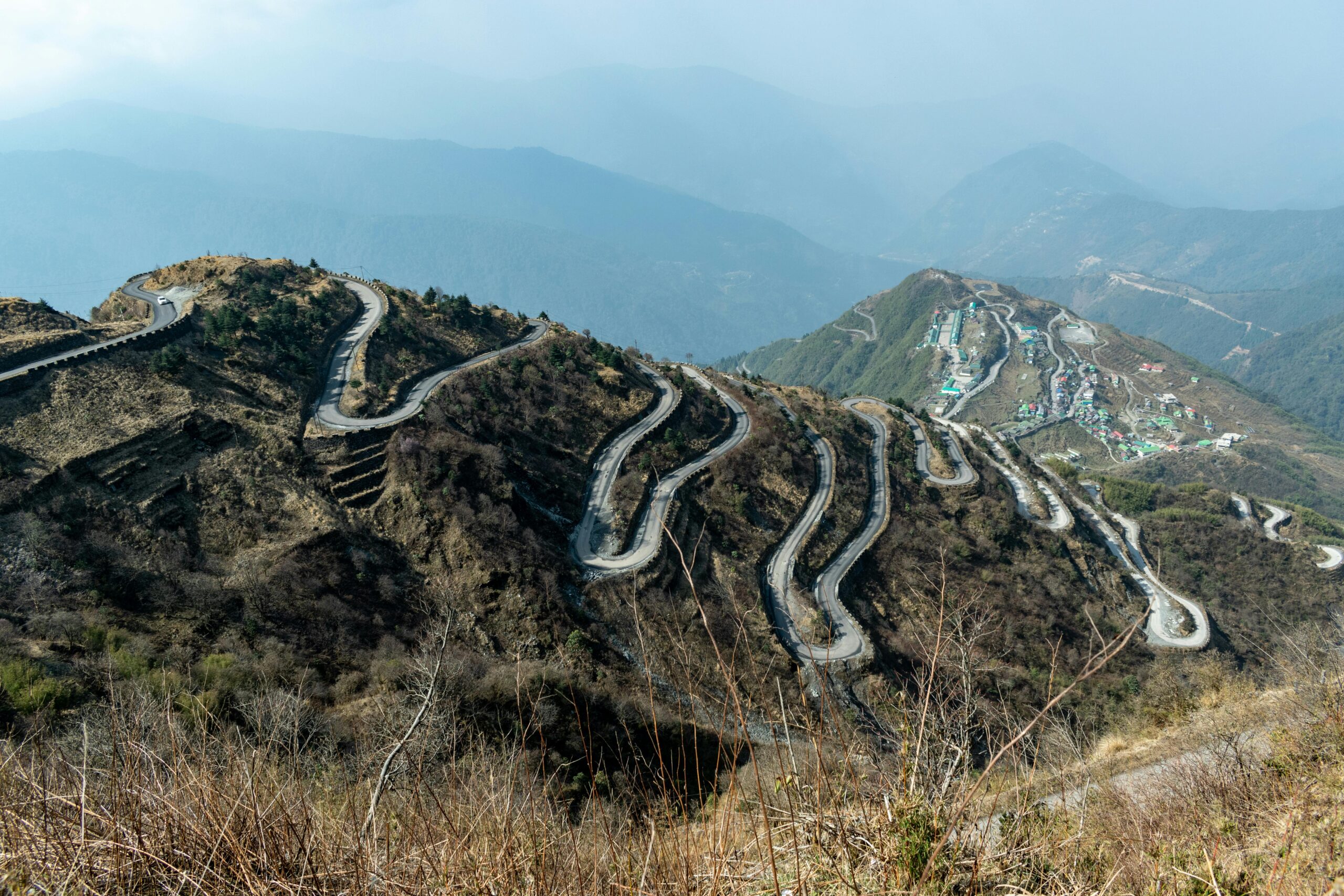
The loops of Zuluk
Somewhere along the way, the road begins to twist in a way that feels almost deliberate.
The famous Zuluk loops appear —
a series of sharp bends climbing up the mountain, each one revealing the next.
From above, it looks like a pattern drawn across the hills.
From inside the vehicle, it’s quieter.
Just one turn after another,
each opening a slightly wider view.
Thambi Viewpoint, where the horizon opens
If the weather allows, sunrise from Thambi Viewpoint feels different.
Not dramatic. Not loud.
Just light slowly touching the peaks,
revealing layers of mountains that seemed hidden in the dark.
On clear days, even Kanchenjunga appears — distant, but unmistakable.
It’s not something you rush.
Most people simply stand still, watching the light change.
Villages that feel untouched by time
Places like Zuluk and Nathang aren’t built for tourism.
They exist first as homes, then as stops for travellers.
Houses are simple.
Life is steady.
And the pace doesn’t shift much, even when visitors arrive.
You’ll find small homestays, warm meals, and conversations that don’t feel forced.
It’s less about “hospitality” —
more about sharing space for a while.
Weather decides more than plans
Up here, plans are flexible by nature.
A clear morning can turn into fog within minutes.
A road that feels open can suddenly slow down.
This isn’t inconvenience —
it’s just how the place works.
And once you accept that, the journey feels easier.
The drive itself is the experience
Unlike destinations where you arrive and then explore,
the Silk Route is mostly about the movement.
The stretches between villages.
The quiet pauses on the road.
The feeling of being somewhere slightly removed from everything else.
Some travellers choose to move quickly through it.
Others slow down, often with drivers who are already familiar with these roads, allowing the journey to unfold without rush.
Nathang Valley, where everything feels distant
Further along, Nathang Valley opens up.
Wide, exposed, and shaped by altitude.
The air feels thinner.
The wind carries more weight.
And the landscape begins to feel almost stark.
There isn’t much to “do” here.
And that’s exactly the point.
A different kind of travel
The Silk Route isn’t about ticking places off a list.
It’s about noticing the in-between.
The way roads curve without warning.
The way villages appear and disappear.
The way silence becomes something you’re aware of.
What stays after you leave
Not a single viewpoint.
Not one photograph.
But a collection of small moments:
- the early morning light
- the quiet turns of the road
- the feeling of moving through something older than the journey itself
FAQs
Where is the Silk Route in Sikkim?
It is located in East Sikkim, connecting places like Zuluk, Nathang Valley and nearby high-altitude routes.
Is permit required for Silk Route?
Yes, permits are required and usually arranged through local operators.
What is the best time to visit Zuluk?
Spring and autumn are generally preferred for clearer views and stable weather.